What Campground Guests Expect From Wi-Fi in 2026 (And Why It Affects Your Bookings)
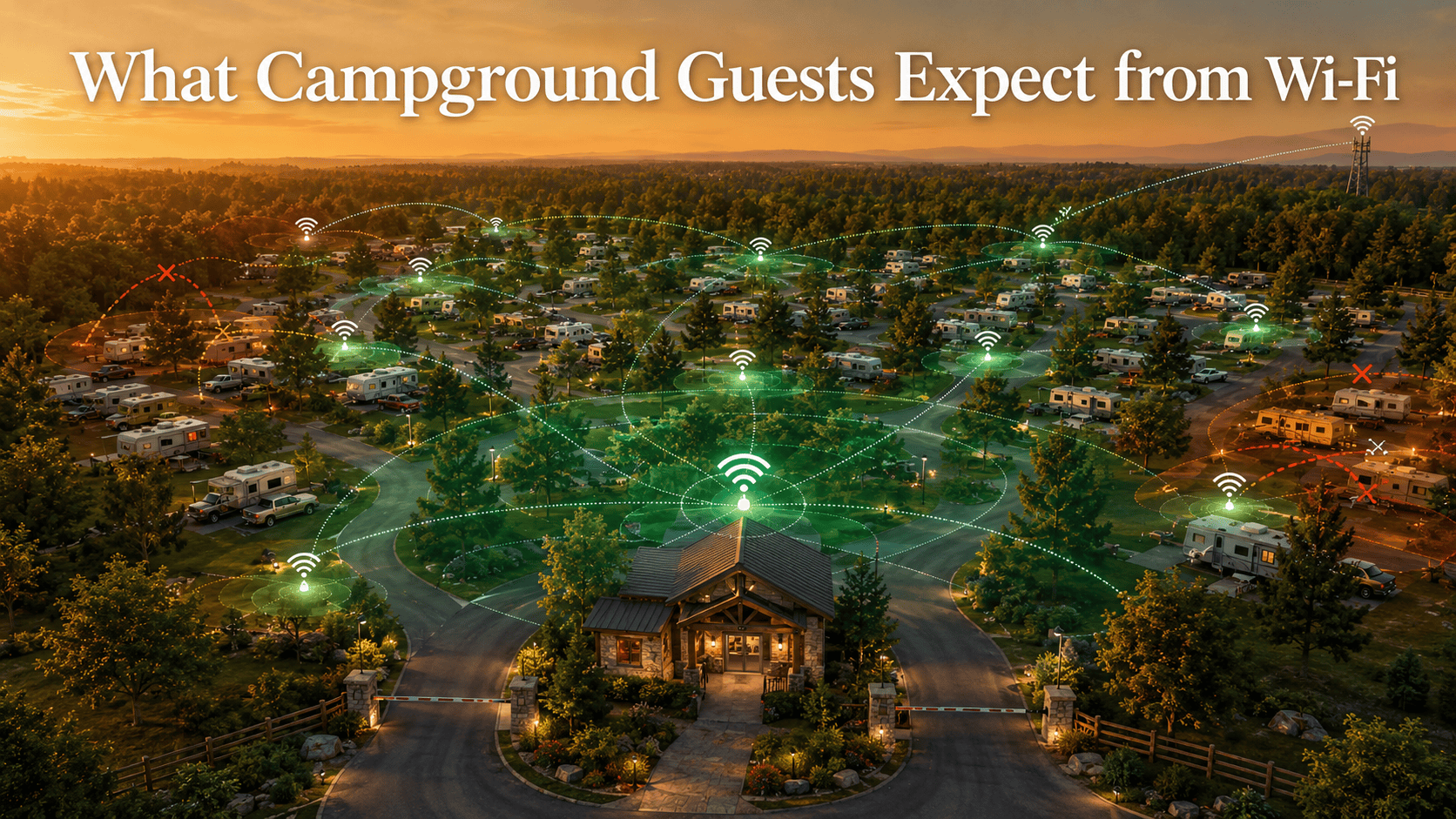
Quick answer: Most campground guests expect reliable Wi-Fi in common areas and around the bathhouse, with enough speed for streaming and video calls (10–25 Mbps). For rural Canadian campgrounds, Starlink is now the most practical solution at roughly $140–250 CAD per month. The bigger opportunity is marketing it correctly: campgrounds that clearly advertise connectivity in their listing descriptions convert meaningfully more bookings from guests who filter by amenities.
For years, campground Wi-Fi was treated as a bonus. Some parks had it, some didn't, and most guests didn't put much weight on it when choosing where to stay. That has changed. In 2026, Wi-Fi has quietly become one of the top filters Canadian guests apply when comparing campgrounds, alongside price, location, and pet policies.
Four things drove the shift: remote work became permanent for a large segment of Canadian workers, families increasingly need connectivity for kids on long drives and in down time, a growing group of digital nomads now actively look for campgrounds that double as workspaces, and everyday AI tools have become part of how guests plan and run their trip (asking ChatGPT for a dinner recipe with whatever's in the cooler, building a long-weekend itinerary, identifying a hiking trail, translating a road sign in Quebec). The result is that Wi-Fi is no longer a quiet bonus. For a meaningful portion of your potential guests, it is a yes-or-no booking factor.
This guide covers what guests actually expect (less than you'd think), what it costs to deliver, and how to turn that amenity into more bookings without overpromising what you can't reliably provide.
Wi-Fi Went From a Perk to a Filter
Four intersecting trends pushed campground Wi-Fi into the booking decision:
Remote work permanence. Statistics Canada data shows roughly 40 percent of Canadians who can work remotely do so at least part of the time. That number stabilised, it didn't shrink. A growing share of those workers now combine camping trips with workdays: arriving Sunday, working Monday and Tuesday remotely, then enjoying the rest of the week unplugged. They need a connection that holds for a Zoom call.
Families with kids. A 6-hour drive to the Kawarthas, the Okanagan, or Cape Breton is only manageable if the kids can watch something at the campground in the evening. Parents filter for Wi-Fi before they filter for price, especially for stays longer than 3 nights.
Digital nomads. A small but fast-growing segment that books longer stays (5 to 14 nights) and spends more per trip than traditional campers, but only at properties that explicitly advertise reliable internet. They actively read reviews looking for Wi-Fi complaints before they book.
Everyday AI tools. This is the quiet shift most operators haven't fully clocked yet. In 2026, guests routinely lean on ChatGPT, Claude, Gemini, and Google AI Overviews for small but constant trip tasks: asking ChatGPT for a one-pot dinner recipe using what's in the cooler, generating a 3-day itinerary for the long weekend ("we're at a campground near Tobermory with two kids, what's worth doing on Saturday"), identifying a plant or a hiking trail from a photo, drafting a quick text to the babysitter, or translating a road sign or menu in rural Quebec. None of these tasks need fast Wi-Fi. They all need Wi-Fi that works, because most rural campgrounds in Canada have poor cellular coverage. When guests can't reach those tools, the trip feels harder than it should. When they can, the campground feels modern and the review reflects it.
The practical signal is straightforward: Wi-Fi is now a top-5 filter on Booking.com, Hipcamp, and Campspot. If you have it but you haven't surfaced it clearly in your listings, you're invisible to the guests who would have booked you because of it.
The demographic shift behind the demand
The reason this matters now in a way it didn't 10 years ago is that the demographic curve has finished moving. A decade ago, a campground owner could reasonably say "our typical guest is a 65-year-old in a Class A motorhome, they don't really use the internet." That's no longer true. According to Statistics Canada's Canadian Internet Use Survey, the share of Canadians aged 65 and over who used the internet in the past 3 months climbed from roughly 58% in 2015 to about 92% in 2024, and is on track to reach 95% in 2026. Younger and middle-aged Canadians were already at saturation; the entire change happened in the demographic that owns the most RVs and books the longest stays.
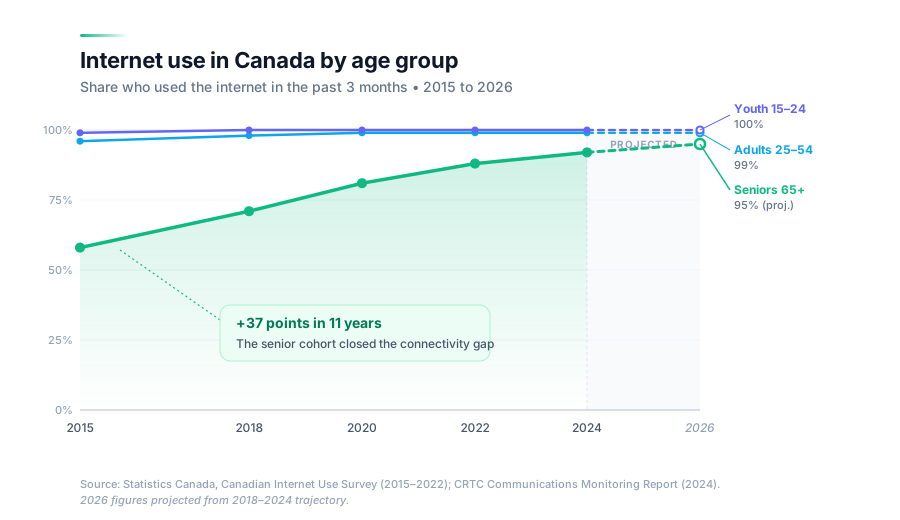
Internet use in Canada by age group (% who used the internet in the past 3 months)
| Year | Youth (15–24) | Adults (25–54) | Seniors (65+) |
|---|---|---|---|
| 2015 | 99% | 96% | 58% |
| 2018 | 100% | 98% | 71% |
| 2020 | 100% | 99% | 81% |
| 2022 | 100% | 99% | 88% |
| 2024 | 100% | 99% | 92% |
| 2026 (projected) | 100% | 99% | 95% |
Source: Statistics Canada Canadian Internet Use Survey (2015–2022) and CRTC Communications Monitoring Report (2024). 2026 figures are projected from the 2018–2024 trajectory.
Three things change as a result. First, the boomer RV camper, historically the most reliable repeat-booking segment at Canadian campgrounds, now arrives expecting connectivity. They use it for grandchild video calls, weather and route apps, ebooks, banking, and increasingly for AI tools that help them plan their day. Second, the multi-generational family trip (grandparents in a fifth wheel, parents in a trailer, kids in a tent) now has every generation expecting Wi-Fi for their own reasons. Third, the standard for what counts as "connected" has reset upward: a campground that was considered well-equipped in 2015 with one weak signal at the office is now considered poorly equipped in 2026.
What Guests Actually Expect (It's Less Than You Think)
Before spending anything on infrastructure, it helps to reset expectations in both directions. Most operators either over-promise (advertising "high-speed Wi-Fi" when they have a single weak access point in the office) or assume they need an enterprise build (when a single Starlink dish and a mesh router would solve the problem).
Speed tiers that matter:
- Basic browsing and social media: 5 Mbps is sufficient
- Streaming Netflix, Disney+, YouTube: 10–15 Mbps
- Video calls on Zoom, Teams, Google Meet: 15–25 Mbps
- Remote work with file uploads and cloud apps: 25 Mbps or higher recommended
Reliability matters more than raw speed. A 15 Mbps connection that holds steady for the entire stay will generate better reviews than a 50 Mbps connection that drops twice an hour. Guests will overlook slow. They will not overlook disconnecting in the middle of a work call or losing the kids' movie at bedtime.
Realistic coverage expectations:
- Common area or picnic pavilion: expected by most guests
- Washroom and bathhouse area: highly valued (it's where phones get charged anyway)
- At every site: not expected, but a strong selling point if you can deliver it
- At the back tent sites or remote loops: no guest expects coverage there
Keep access simple. A single network name and a posted password at check-in reduces staff calls dramatically. Networks that require per-device registration or a captive portal login frustrate guests, and the friction shows up in reviews. Hotel-style portal logins are not what camping guests want.
Your Options in Canada, by Region
This is where the post gets practical. The Canadian internet market is regional, and what works in Cape Breton is different from what works in the Alberta foothills. Here's what to actually buy and who to actually call.
Starlink: the rural game-changer for every province
Starlink satellite internet is now available across virtually all of Canada, including Cape Breton, the Ontario Shield, the Peace Country in Alberta, the BC interior, and the Maritimes coastline where no ISP ever ran cable. For rural campgrounds that historically couldn't get broadband, this is the single most significant infrastructure development in the last decade. It works where nothing else does.
- Starlink Business plan: roughly $250 CAD per month, hardware around $575 CAD (dish and router, one-time)
- Starlink Residential plan (if your park is in a region where it's offered): roughly $140 CAD per month, hardware around $349 CAD
- Order or check availability at starlink.com; Canadian pricing shows at checkout
One Starlink dish, connected to a mesh Wi-Fi system, can reliably cover a common area, an office, a bathhouse, and a number of nearby sites. Larger resort-scale operations sometimes add a second dish for redundancy and to extend coverage to a second zone. Installation is typically under an hour and does not require a technician.
Operator note: campgrounds in rural Nova Scotia (Annapolis Valley, South Shore), northern Ontario (Muskoka, the Algonquin fringe, Northumberland), and the Alberta foothills have widely reported switching from cellular boosters to Starlink and cutting guest Wi-Fi complaints by more than half within a single season.
Traditional ISP options by province
When a campground sits within a community already served by cable or fibre, a business-grade ISP plan is often faster and more affordable than Starlink. Here's who to contact by region:
| Province | Main ISPs to call |
|---|---|
| Nova Scotia, PEI, NB, NL | Eastlink Business is the dominant Maritime provider; business internet from $80–200 CAD per month |
| Ontario | Rogers Business, Bell Business, Cogeco in southwestern ON, Xplore (formerly Xplornet) for rural areas |
| Alberta | Telus Business, Rogers Business (formerly Shaw in AB), Xplore for rural areas |
| Quebec | Videotron Affaires, Bell Business |
| Saskatchewan, Manitoba | SaskTel, Bell MTS |
| British Columbia | Telus Business, Rogers Business |
Most of these providers will run a cable to your office or main utility building and install a modem there. From that point, a mesh router system distributes coverage. Monthly cost for a business plan in the 100–250 Mbps range typically falls between $100 and $250 CAD depending on region and provider.
Xplore (formerly Xplornet) deserves a specific call-out for rural Canadian campgrounds. It's a Canadian fixed-wireless, fibre, and satellite provider that has historically targeted agricultural and rural customers, and many existing campgrounds in Ontario and the Prairie provinces already use it. Plans range from modest fixed-wireless speeds (25–50 Mbps) up to 5G Ultra packages reaching 500 Mbps in newly expanded coverage areas. It's often the practical bridge option when Starlink isn't a fit and cable doesn't reach.
Commercial Wi-Fi equipment: what campgrounds actually deploy
A single residential router or consumer mesh kit will not cover a campground reliably. Trees, RVs, weather, and concurrent device counts (a 50-site park can easily hit 200+ connected devices on a busy weekend) overwhelm consumer gear within a season. The commercial systems below are what RV parks and campgrounds across Canada and the northern US actually deploy, in roughly increasing order of cost and capability.
Ubiquiti UniFi (the dominant choice in the industry). UniFi is the single most common commercial Wi-Fi platform at independent campgrounds across North America. It hits the right balance: commercial-grade outdoor access points, central management, captive portal support, voucher systems for per-stay guest codes, and pricing that doesn't require an enterprise budget.
- Typical build: a UniFi Dream Machine SE (gateway and controller, ~\(700 CAD) plus 4–8 outdoor access points like the [U7 Pro Outdoor](https://store.ui.com/ca/en) or [Mesh Pro](https://store.ui.com/ca/en) (~\)250–400 CAD each, PoE-powered).
- Total hardware cost for a 50–100 site park: roughly $2,500–5,000 CAD.
- Setup requires either a tech-comfortable owner or a half-day installer visit. Once configured, ongoing management is minimal.
TP-Link Omada (the value alternative to UniFi). Same architecture as UniFi (controller plus outdoor APs), typically 20–30% cheaper. The Omada EAP610-Outdoor and similar models are weather-rated and PoE-powered. Common at smaller parks where UniFi pricing feels steep.
Cambium Networks (the resort-scale choice). Larger RV resorts and 200+ site parks typically deploy Cambium cnPilot outdoor APs (e510, e700, and XV series), which are designed for outdoor industrial deployment and can be paired with Cambium ePMP point-to-multipoint links to distribute internet across a large property without trenching cable everywhere. Cambium has a dedicated RV parks and campgrounds product line and is well-represented in the larger Canadian and US resort segment. Expect $5,000–15,000 CAD for a full property buildout.
Managed Wi-Fi services (for operators who don't want to own it). Two providers specifically serve the North American campground and RV park market end-to-end (design, install, monitoring, ongoing support), typically billed as a per-site monthly fee:
- TengoInternet has been the category leader since 2002 and is deployed at thousands of parks across North America.
- AccessParks is the other widely-used option, notable for offering a contractual SLA (uncommon in the industry).
Expect roughly $3–8 CAD per site per month for managed service. For owners who don't want to think about Wi-Fi at all, this is the path. Most large Canadian and US RV resort chains use one of these providers.
Proven deployment patterns from working campground builds:
- Mount outdoor APs on existing infrastructure (light poles, pavilion ridgelines, building corners, hydro pedestals). One outdoor AP covers roughly 60–90 metres of clear line-of-sight; trees and RVs cut that in half.
- Use Power-over-Ethernet (PoE) so you only need to run one CAT6 cable to each AP location, not separate power.
- Wireless backhaul instead of trenching. When buried cable isn't practical between buildings, point-to-point wireless bridges (UniFi Building Bridge, Cambium ePMP) move internet between zones over the air.
- Captive portal for legal protection. A simple splash page that displays your acceptable use policy (no torrenting, no illegal content, network is provided as a courtesy, etc.) protects you legally if a guest uses your network for something they shouldn't. UniFi, Omada, and Cambium all support this without adding meaningful guest friction.
- Per-stay voucher codes (optional). Some operators issue a Wi-Fi code printed on the check-in sheet, which expires when the reservation ends. This prevents former guests and neighbours from camping on your bandwidth and gives you per-device visibility if something goes wrong.
Cellular signal boosters: the honest picture
A cellular booster like weBoost amplifies the existing LTE or 5G signal from nearby towers. It improves your guests' own phone data and personal hotspots. It does not create a campground Wi-Fi network. Hardware costs $400–900 CAD one-time, with no monthly fee.
This is the right call when you want to improve guest cellular experience before committing to a full Wi-Fi buildout, or when your region has decent LTE coverage but weak signal indoors or at sites. Be clear in your listings: you offer signal boosting, not campground Wi-Fi. The distinction matters to guests who specifically need a shared network for work.
What's actually overkill
What you do not need: a fully-managed Cisco Meraki deployment with per-user analytics dashboards, VLAN segmentation for guest isolation across 12 SSIDs, or a $20,000–40,000 enterprise hotel system. That's hotel and conference centre infrastructure. The commercial gear above (UniFi, Omada, Cambium, or a managed service) gives you everything a campground actually needs at a fraction of that cost.
Coverage Zones: You Don't Have to Wire the Whole Property
Strategic zoning is more realistic and more honest than trying to blanket your entire property with Wi-Fi. Most successful campgrounds think about Wi-Fi in three zones.
Zone 1, must-have: Reception and office area. Guests need it for check-in, asking questions, and looking up reservation details.
Zone 2, high-value: Common area, pavilion, camp store, and the entrance to the bathhouse. This is where coverage matters most to the broadest range of guests, and it's the easiest area to reliably cover from one or two access points.
Zone 3, selling point: A declared "connected zone," meaning a specific group of sites or a seating area you market as having strong signal. Operators who name this zone in their listing (and on a small map at check-in) can sometimes charge a small premium for those specific sites without pushback.
The honest "disconnect zone" play. Some guests actively want to unplug. Back-country tent sites or remote loops with no Wi-Fi can be marketed as off-grid sites or as a disconnect zone. This is a feature, not a flaw, but only when you flag it clearly in the site description so the right guest books the right site.
How to Turn Wi-Fi Into a Booking Driver
Having Wi-Fi is not enough. The operators winning bookings from connectivity-sensitive guests are the ones who surface it clearly at every stage of the booking journey.
In your booking system site descriptions. Each site or site type should explicitly mention Wi-Fi availability in the description field. "Wi-Fi included, strong signal near common area" outperforms a generic amenity checkbox by a wide margin. For sites in your connected zone, say so. For off-grid sites, say that too.
In your Google Business Profile. Add Wi-Fi to your listed amenities (it's a checkbox in GBP). Then include it in your description text: "Wi-Fi available at common areas and select sites." This is exactly the kind of language that feeds AI Overview answers when someone asks "does [your campground name] have wifi" or "Canadian campgrounds with Wi-Fi for remote work."
In your listing photos. A photo of your picnic pavilion or common area with a small sign showing the Wi-Fi network name reads as a trust signal. It's not hokey, it's clear. Guests scan photos for exactly this kind of practical detail before they book.
Language that converts.
- "Wi-Fi included at no extra charge" reassures price-sensitive guests
- "Fast enough for video calls in our common area" is specific and believable
- Avoid "complimentary high-speed Wi-Fi" because it reads as hotel marketing language and triggers skepticism in camping guests
Responding to Wi-Fi mentions in reviews. When a guest mentions Wi-Fi positively in a review, respond and name the amenity by what it does: "Glad the internet held up for your work calls, we upgraded to a dedicated Starlink connection this season." This reinforces the signal for future readers and strengthens how your listing is indexed by Google.
When You Can't Deliver, Say So
Don't overpromise. A campground that lists "Wi-Fi available" and delivers one bar of LTE will get penalised in reviews, and bad Wi-Fi reviews are the kind future bookers actively search for. Honest framing performs better than vague promises.
- If coverage is partial: "Wi-Fi available in the main lodge and shower area. No signal at back tent sites." Guests who need connectivity book accordingly; guests who don't care are unaffected.
- If you're Starlink-dependent and weather affects signal: note in your pre-arrival check-in messaging that satellite internet can be affected by heavy rain or storms. Setting expectations before the complaint usually prevents the complaint.
- If you're cellular-booster-only: don't call it "campground Wi-Fi." Say "cell signal booster on property, bring your own data plan." The distinction protects your reviews.
The standard to meet is simple: no guest should be surprised by your connectivity situation when they arrive.
Frequently Asked Questions
How fast does campground Wi-Fi need to be?
For most guests, 15 to 25 Mbps is sufficient for streaming and video calls. The more important factor is reliability. A consistent 15 Mbps connection that holds steady all stay will generate better reviews than a variable 50 Mbps connection that drops periodically.
What's the best internet option for a rural Canadian campground?
Starlink is now the most practical choice for campgrounds outside cable or fibre coverage. It works across all of Canada, including the Maritimes, northern Ontario, the Alberta foothills, and the BC interior. Hardware runs roughly $349–575 CAD one-time, and plans start at about $140 CAD per month. If your park is in a served area, check Eastlink (Maritimes), Telus (BC and Alberta), Rogers, Bell, Cogeco, Videotron, SaskTel, or Xplore (formerly Xplornet) for potentially faster and cheaper options.
Should I charge guests extra for Wi-Fi?
In most cases, no. Guests have come to expect Wi-Fi as included, and adding a fee creates friction at checkout and negative review commentary. Build the cost into your base site rate instead. The exception is a premium "connected zone" tier where you charge slightly more for a specific cluster of sites that get strong signal.
How do I advertise Wi-Fi to get more bookings from it?
Add it explicitly to each site description in your booking system, check the Wi-Fi amenity box in your Google Business Profile, and mention connection speed in your GBP description text. Vague "Wi-Fi available" listings are effectively invisible to guests who filter by connectivity. Specific language ("fast enough for video calls in the common area") converts noticeably better.
What if guests complain that the Wi-Fi is slow?
Respond publicly in your review reply by naming any upgrades you've made or plan to make: "We upgraded to a dedicated Starlink connection in spring 2026, the signal in the common area is considerably stronger this season." This turns a negative signal into a trust-building one for the next person reading your reviews.
Related Reading
- Campground SEO: How to Get Your Park to Show Up on Google
- Campground Photography: How to Take Booking-Winning Photos of Your Park
- How to Create Campground Add-Ons That Guests Can't Say No To
- How to Get More Campground Google Reviews
Better amenities drive more direct bookings, but only if guests can see them.
PitchCamp's per-site listing descriptions let you specify exactly what each site offers: connectivity zone, signal quality, distance from the bathhouse, and anything else that matters. Guests see the details that affect their decision before they book, which means fewer phone calls and more confident reservations.
Book a Free Demo or Start for Free free to get started. 🍁
Tags: campground wifi Canada · campground internet setup · rv park wifi · Starlink campground Canada · Eastlink campground · campground wifi Nova Scotia · campground wifi Ontario · campground wifi Alberta · digital nomad camping · PitchCamp